7 Deadly Sins Test
Which deadly sin sounds most like you? Answer 14 everyday questions and see all seven scores, each out of 6.
Free No sign-up Instant results

 Loading the test…
The seven sins
Pick one to see what it looks like in everyday life.
How the seven deadly sins quiz is scored
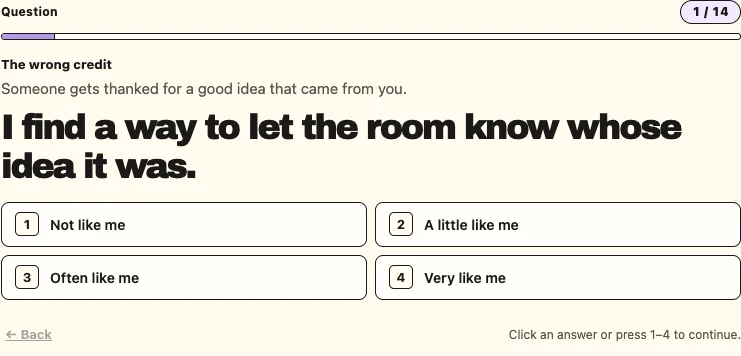
The 7 Deadly Sins Test asks about small moments: getting talked over, wanting the next episode, hearing a friend’s good news. Each prompt gives you a scene and a possible reaction. Choose how much that reaction sounds like you. The useful answer is the one you recognize, even if you would act differently after a moment to think.
Two prompts, six possible points
Each of the seven impulses gets two prompts. “Not like me” earns zero points, “A little like me” earns one, “Often like me” earns two, and “Very like me” earns three. Both prompts count equally. For example, if you choose “Often” for one pride prompt and “A little” for the other, your pride score is 3 out of 6. That number describes two answers; it does not mean you are 50% proud.
See a full example with two tied scores.
Tap an answer or press 1–4 on your keyboard to continue. Use Back if you want to change your choice.
Which deadly sin is strongest for me?
Look for the highest score on your card. If Pride and Envy both reach 4 and the other five score lower, both are your strongest tendencies for this set of answers.
How accurate is the result?
This is an original quiz for fun and self-reflection. It hasn’t been validated as a measure of personality. A score of 5 for envy and 4 for pride means just one answer step separates them. Look back at the two scenes behind each score before treating either word as a label.
What each sin means
Pride
Pride shows up here as the wish to protect how you are seen. You might enjoy praise and still accept a correction with ease. The prompts look at the next beat: does setting the record straight matter for the work, or mostly because other people are watching?
Envy
Envy looks sideways. A friend gets the invitation you were hoping for, and suddenly the invitation seems to say something about you. Wanting an experience of your own is a different feeling. The envy prompts ask how often another person’s good fortune changes what your own life feels like.
Sloth
Sloth in these prompts means putting off a manageable action when you have the energy and opportunity to do it. Rest after a difficult day is not the situation being scored. Picture a small promise that stays on your list mainly because beginning it feels less appealing than doing almost anything else.
Wrath
Wrath is the part of anger that wants an injury returned. Wanting someone to stop interrupting you is a boundary. Wanting the entire room to laugh at them is a different impulse. Notice which part of the scene you are answering: the wish for things to change or the wish to get even.
Gluttony
Gluttony here means continuing past the moment of satisfaction. It might be the encore after a perfect ending, or an episode that you watch without really enjoying it. The prompts are about where you would have liked to stop. They make no judgment about food, appetite or anyone’s body.
Lust
In this test, lust is the pull of chemistry and the excitement of being desired. Think of a conversation in which the anticipation was more vivid than anything you actually learned about the other person. Attraction itself is ordinary. The question is what gets your attention once the spark arrives.
Greed
Greed is about having more to keep. A spare ticket is useful until somebody else actually needs it and you still cannot bear to part with it. Compare that feeling with gluttony: greed wants the unopened box on the shelf; gluttony wants to open the next one now.
Common questions
What if the test won’t start?
The quiz needs JavaScript. Enable it in your browser and reload the page. If loading fails, select Try again or open the standalone test. Refreshing or opening a new test clears your current progress.
Open the standalone testCan I take the test on my phone without signing up?
Yes. Open this page in your phone or computer browser and select Start the test. All 14 questions and the full result are free. You don’t need an account, an email address or an app.
How long does the 7 Deadly Sins Test take?
At 15 seconds per question, the 14 questions take about 3½ minutes. There’s no timer, so you can pause on a tricky choice or go back and change an answer before reading your scores.
Will I see all seven scores or just my strongest sin?
You see all seven scores on the result card, each out of 6, alongside a seven-axis chart. The highest score shows which pair of scenarios sounded most like you. If several share the highest score, the card shows the tie.
How can I share my results with friends?
On your result card, select Copy my scores to copy all seven scores and the result heading. You can paste them into a message or take a screenshot of the chart. Share test sends the quiz link so your friend starts at question one. Your answers and scores stay out of that link.
What happens if two scores tie?
The 7 Deadly Sins Test lists every tendency tied for the highest score. If all seven are equal, the card says so. The order of equally long bars is only a display choice. It does not give one tendency an edge.
Can I change an answer or take it again?
Yes. Use Back between prompts, or Review answers on your result card. Retake the test clears all fourteen choices. Starting again can be interesting if you want to compare a recent week with how you usually feel; the site does not store the earlier card for you.
How is this different from a personality type test?
This quiz gives you seven separate scores for reactions to everyday situations. You can recognize yourself in both envy and pride, for example. It doesn’t assign a fixed personality type or rank you against other players.
Is this about religion or anime?
The names come from the traditional list of seven vices. Here they describe everyday reactions. You do not need any religious knowledge, and the result will not match you with an anime character. Read it as a conversation starter, not a verdict about your beliefs or character.
Comments
Which answer gave you pause? Share the question that made you think.